Le luxe des Mameluks était très grand; ils portaient tous des chemises de mousseline et des pelisses de soie. Quant à leurs armes, elles étaient incrustées d'ivoire et de pierreries finement taillées. Ils étaient armés jusqu'aux dents et portaient jusqu'à quatre ou cinq - pistolets à la ceinture. Leurs sabres recourbés coupent comme des rasoirs et tranchent une tête d'un seul coup bien appliqué.
L'armée française en Égypte 1798-1801, M. Vertray, par H. Galli, 1883.
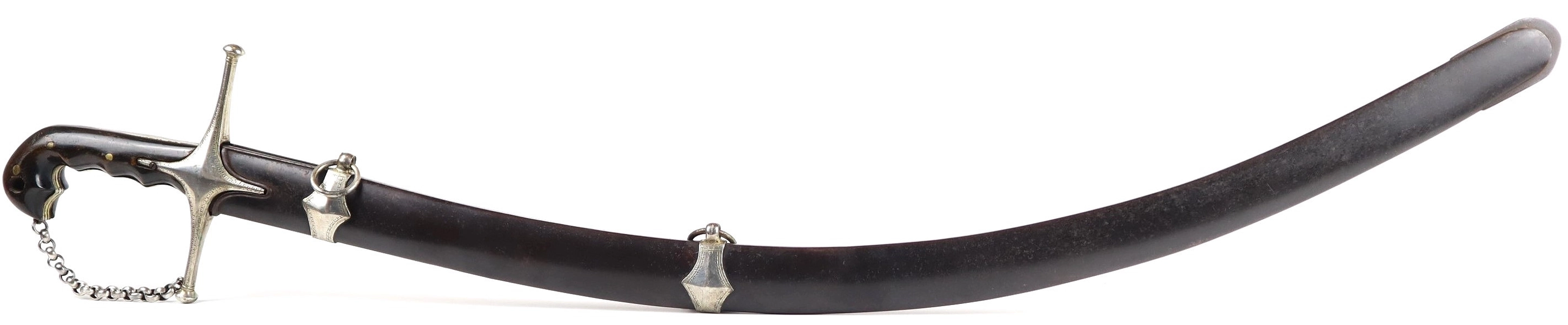
Shamshir First French Empire
Country of origin : Ottoman Empire / France
Dating : blade 18th, mounts 19th century
Materials : Gilded silver, Wootz, Horn, Iron
Total length : 93.5 cm
Blade length : 74.0 cm
The shamshir and kilij are iconic sabres of the Ottoman Empire, Persia, India, and the Arabian Peninsula. Their blades, often forged from wootz steel, typically feature a pronounced or subtle curve. The pistol-grip handles, cross-guards, and scabbards with two suspension rings, adorned with brass, silver, or gold fittings, and decorated in repoussé, are characteristic of these weapons.
As with many historical examples, these sabres range from utilitarian models to prestigious pieces. The origin of the blades can vary and is sometimes identifiable if they bear a signature. Often, the decorations, the shape of the scabbard, or the handle are what help determine the country in which the sabre was used.
These weapons tended to circulate between different countries, being offered as diplomatic gifts, captured in wars, and so on. A perfect example is sabre no. 36.25.12.93 from the Metropolitan Museum, which combines an Indian handle, an Ottoman guard, and a Persian blade.


Napoleon himself had a great appreciation for Mamluk sabres, owning several examples. He presented them as gifts to his most deserving officers and soldiers, thus making the Mamluk sabre a symbol of prestige in the Napoleonic cavalry, especially among officers.


Our example closely resembles the sabre carried by General Lasalle (housed in the Army Museum), both in its overall shape and in certain details. The blade, of Ottoman or Persian origin, was likely brought back during the Egyptian campaign. Forged from exceptionally high-quality wootz, it stands out for its particularly vivid surface activity. The blade is polished, with a slight bevel along the spine, and its tip has been fitted with an additional false edge.
The guard and suspension rings, made of silver formerly gilded, also appear to be of Middle Eastern craftsmanship. In contrast, the horn grip, silver chain, and bronzed scabbard are of French origin.
This officer’s sabre, dating from the late 18th to early 19th century, beautifully combines the allure of Oriental blades with the elegance of French military sabres.


Please, do not hesitate to contact us if you would like more photographs or information.