Peu de temps avant notre départ de Constantinople, sultan Selim s'est contenté de prendre un riche cangear [...], grand couteau que les Musulmans portent à la ceinture, dont la poignée est en argent, en or, en ivoire, en jaspe, en corail, enrichie d'émeraudes, de rubis, de diamants.
Voyage dans l'Empire Ottoman, Guillaume Antoine Olivier, 1800.
Wootz Ottoman Khanjar
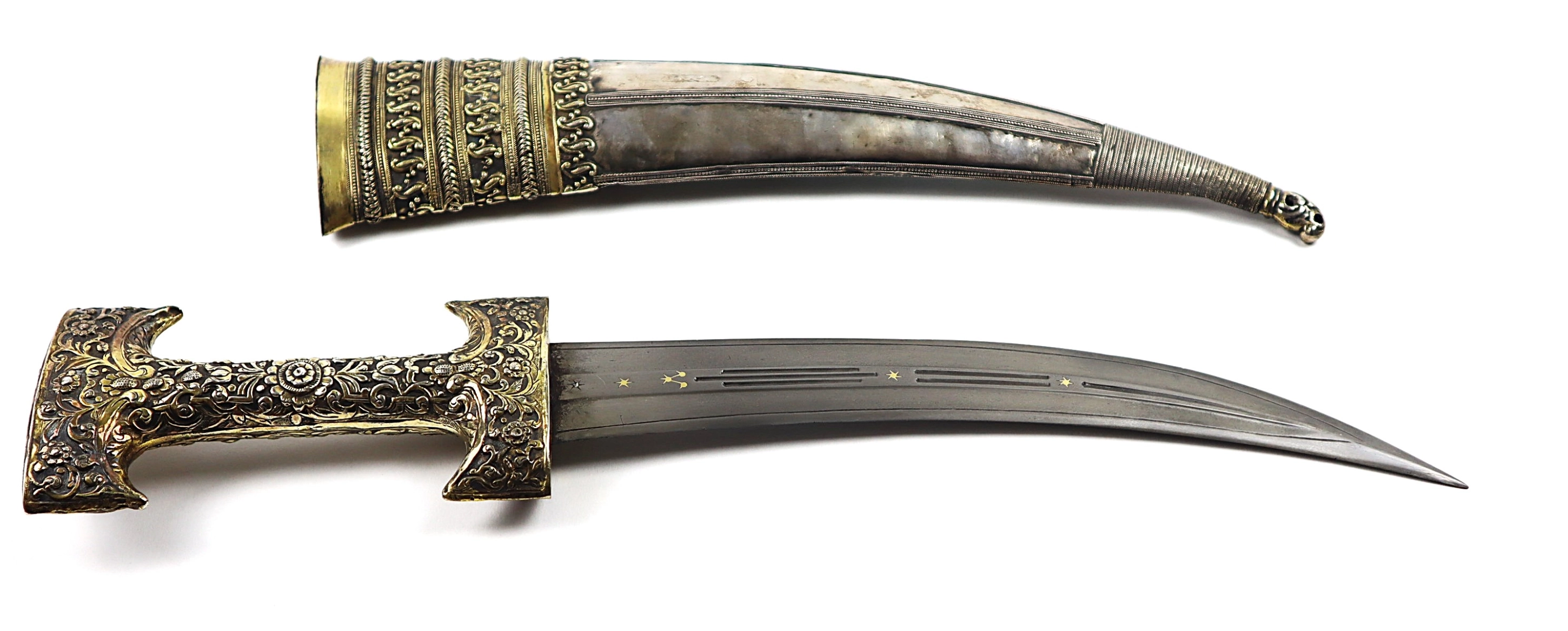
Country of origin : Ottoman Empire
Dating : 19th century
Materials : Gilded silver, Wootz
Total length : 53.0 cm
Blade length : 30.0 cm
The khanjar, called hançer in the Ottoman Empire, is a curved double-edged dagger. Its origins seem very ancient, probably derived from types of curved daggers already in use in the regions of Yemen and Persia. It was adopted and perfected by different cultures of the Middle East and Asia, notably in Persia, the Arabian Peninsula and India, as well as by the Ottoman Empire.
Examples can range from utility daggers to prestige weapons, the former usually being of simpler workmanship, while the latter can be decorated with precious and semi-precious stones, as well as gold and silver. Depending on their origin, these weapons display distinctive characteristics, such as the shape of the handle and blade, the materials used for the handle and scabbard, and the decorative designs.


Please, do not hesitate to contact us if you would like more photographs or information.