These large bowls were beautifully carved out of wood, resembling huge, rather deep champagne glasses on short stems; they were gilt on the outside with red lacquered rims and floral designs.
Prince of the black bone, Life in the Tibetan Borderland, Peter Goullart, 1959.
Yi Powder Horn
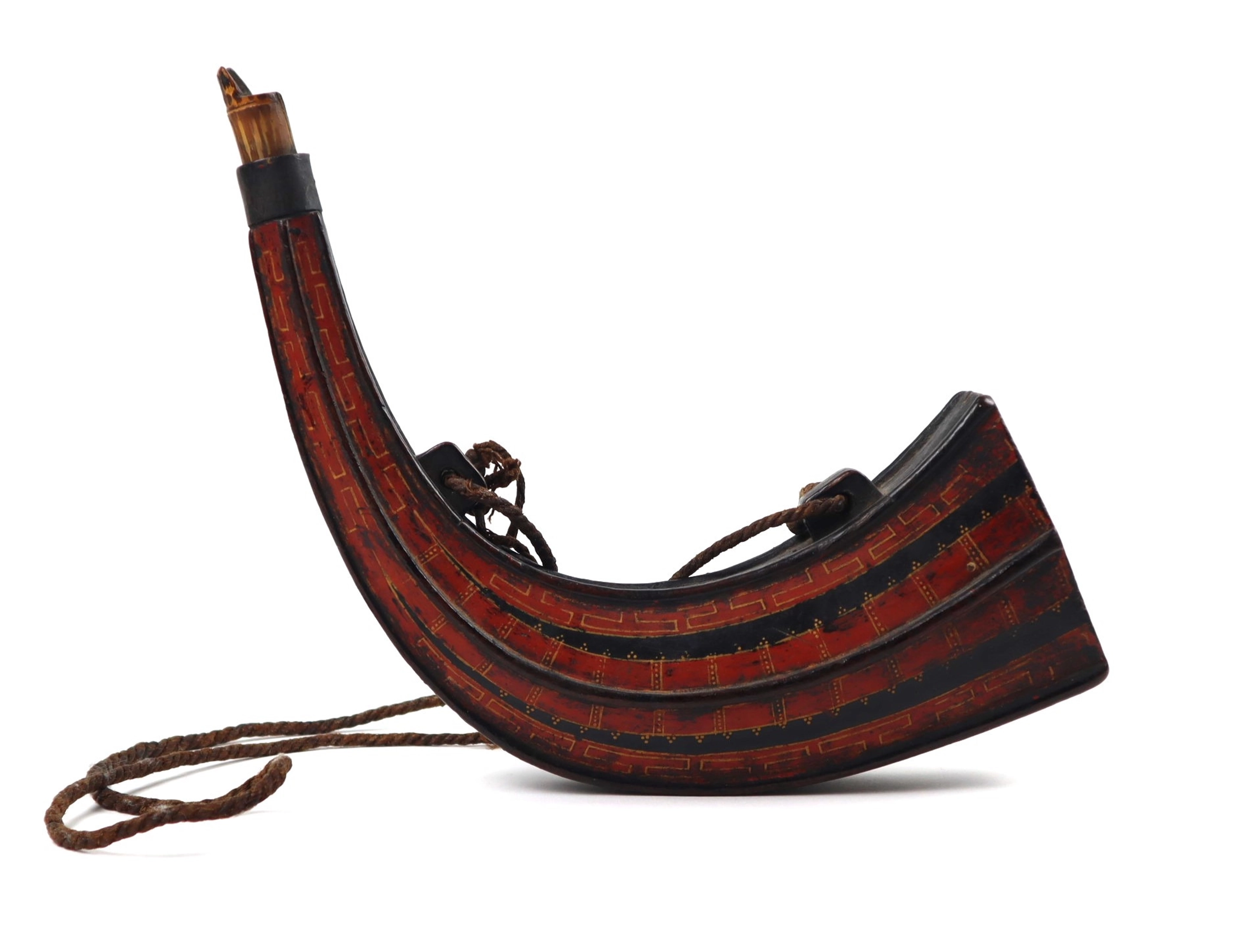
Country of origin : China
Dating : 19th century
Materials : Wood, Lacquer
The Yi (Yízú, 彝族), also called Lolo (luóluǒ, 倮倮), are composed of a multitude of ethnic subgroups, whose languages can be different and sometimes mutually unintelligible. Their geographical distribution is vast: they are found mainly in four regions of China (Yunnan, Sichuan, Guizhou, Guangxi), as well as in several countries of Southeast Asia (Vietnam, Laos, Thailand).
The Yi are said to be descendants of the Eastern Cuan. The latter, also called Wuman or Black Barbarians, were distinct from the Western Cuan (White Barbarians), to whom they were subject, while administering their own territory alone. In the 4th century, they were mainly settled in the mountainous regions of eastern Yunnan. Until the fall of the Kingdom of Nanzhao (in 902) and the Kingdom of Dali (in 1253), the Yi and the Bai coexisted, organized into castes, the Yi being mainly subjects of the Bai. Already at this time, the Yi were renowned for their lacquered objects, especially armor. A Yi armor preserved at the Metropolitan Museum in New York has been carbon-dated and dates back to the 12th-13th century.


Please, do not hesitate to contact us if you would like more photographs or information.